Technology
How AI Eliminates Friction Without Sacrificing Security
Authentication has become a constant balancing act. Users want fast, smooth access to the systems they rely on every day. Security teams want airtight protection against sophisticated attackers. Regulators and auditors want proof that controls are consistent and effective. Somewhere between these competing demands, most organizations end up with an approach that frustrates users, overburdens IT, and still leaves room for attackers to slip through.
Traditional MFA workflows are part of the problem. Forcing MFA at every login slows down productivity, creates fatigue, and drives users toward workarounds that defeat the purpose of the control. On the other hand, relying on passwords alone exposes companies to credential theft, session hijacking, and automated attacks that operate at massive scale. Static risk rules make the problem even worse. They are rigid, noisy, and blind to emerging threat patterns.
HAWCX takes this problem off the table by introducing Adaptive Authentication Intelligence. Instead of treating every login the same, the system evaluates risk in real time and tailors the experience to the situation. If a login matches a user’s normal behavior, access is seamless and passwordless. If something looks unusual, the system requests quick verification. If something looks dangerous, access is blocked and the security team is notified instantly.
Why the old model no longer works
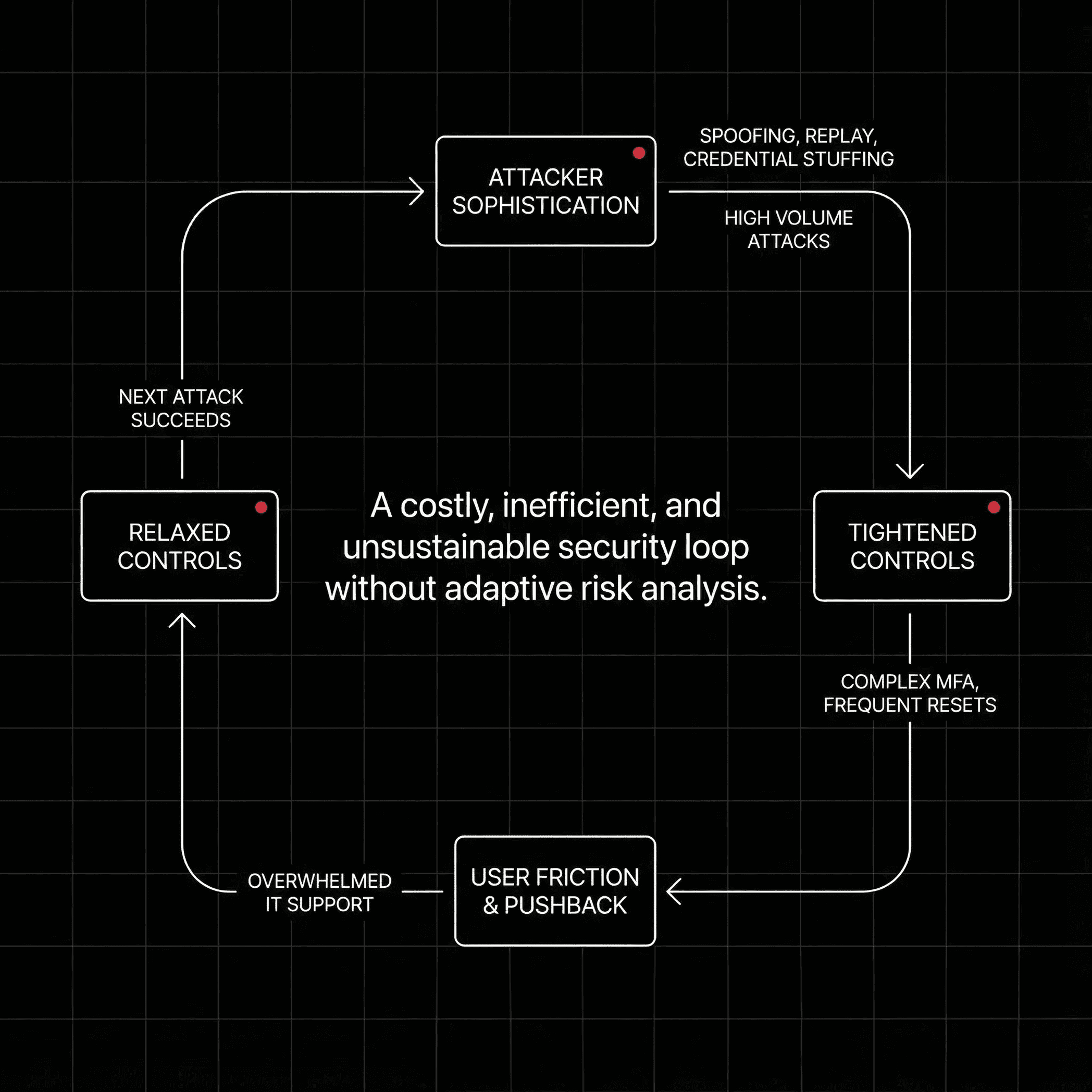
Attackers have become far more sophisticated. Commodity tools can spoof devices, rotate IP addresses, replay stolen sessions, and launch credential stuffing attacks that test thousands of accounts in minutes. Meanwhile, users expect consumer grade convenience. They do not tolerate unnecessary friction, especially when they access work systems multiple times per day.
The result is a familiar pattern. Security leaders tighten controls after an incident. Users push back. IT teams get overwhelmed by password resets and MFA tickets. Eventually the controls are relaxed again, often just enough for the next attack to succeed. Without adaptive risk analysis, organizations are stuck in a loop that is costly, inefficient, and unsustainable.
How HAWCX solves the problem
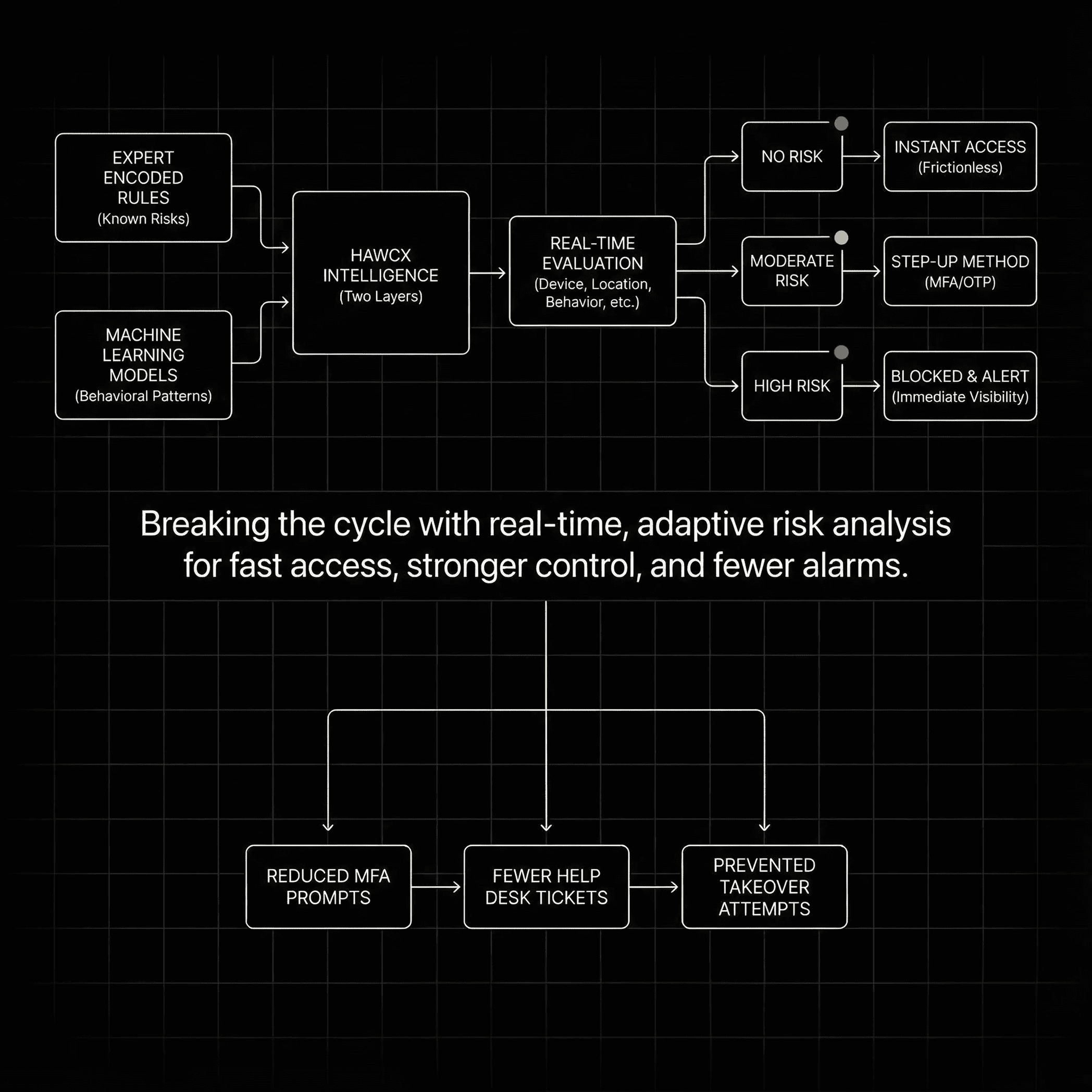
HAWCX uses two layers of intelligence to break this cycle. Expert encoded rules detect known risks such as large geographic jumps, new devices, and sudden login bursts. Machine learning models analyze behavioral signals and look for patterns that do not match a user’s historical profile. This combination allows HAWCX to understand context and nuance, not just simple if then conditions.
Every login is evaluated in milliseconds. The system reviews device details, location, timing patterns, past behavior, and a range of environmental signals. If the activity poses no risk, users continue without interruption. If moderate risk is detected, HAWCX applies a fast step up method such as a push approval or one time passcode. If high risk is detected, the event is blocked entirely and security teams receive immediate visibility.
The impact is significant. Organizations reduce MFA prompts, cut help desk volumes, and prevent account takeover attempts before they escalate. Users experience a login flow that feels fast and modern rather than outdated and punitive. Security teams get stronger controls with better signal quality and fewer false alarms.
Built for real world environments
Adaptive authentication only works if it fits naturally into existing infrastructure. HAWCX integrates with common identity stacks, API gateways, SaaS applications, and mobile or web clients without requiring major architectural changes. The system includes tenant level configuration, full audit logging, and privacy controls suitable for regulated industries.
Because every decision is logged with clear reasoning, audits become easier. Because risk thresholds are configurable, organizations can match the system to their unique environment. Because the intelligence is autonomous and always learning, protection improves continuously without manual tuning.
The path forward
Authentication does not need to be a tug of war between convenience and security. With adaptive intelligence applied at the point of login, organizations can finally provide users with the fast, frictionless experience they expect while increasing the strength and reliability of their defenses.
HAWCX makes this possible by understanding real behavior, detecting real risk, and applying real intelligence at the moment it matters most. This is what modern authentication should look like.